
Shashi Shankar
Mar 21, 2023
Introducing Modern Data Platform and Lakehouse
Intro
A modern data platform on AWS offers a comprehensive set of capabilities to help organizations effectively manage, analyze, and derive insights from their data, empowering data-driven decision-making and innovation.
Scalability:
AWS offers scalable infrastructure, allowing organizations to dynamically adjust resources based on workload demands. This scalability enables handling of large volumes of data without compromising performance.
Flexibility:
Modern data platforms on AWS provide flexibility in terms of data storage and processing options. Organizations can choose from a variety of storage solutions like Amazon S3, Amazon RDS, Amazon Redshift, and Amazon DynamoDB, as well as processing frameworks such as Apache Spark, Apache Hadoop, and AWS Glue.
Cost-effectiveness:
AWS offers a pay-as-you-go pricing model, allowing organizations to pay only for the resources they consume. This cost-effectiveness is particularly beneficial for managing fluctuating workloads and optimizing resource utilization.
Security and Compliance:
AWS provides robust security features and compliance controls to protect data stored and processed on the platform. This includes encryption, access controls, audit logging, and compliance certifications to meet regulatory requirements and industry standards.
Integration with AI and ML: Modern data platforms on AWS seamlessly integrate with artificial intelligence (AI) and machine learning (ML) services such as Amazon SageMaker, Amazon Comprehend, and Amazon Rekognition. This enables organizations to derive insights from their data using advanced analytics and AI/ML algorithms.
Data Lakes and Data Warehouses:
AWS offers services like Amazon S3 for building data lakes and Amazon Redshift for building data warehouses. These services provide scalable and cost-effective solutions for storing and analyzing structured and unstructured data.
Real-time Data Processing:
AWS supports real-time data processing through services like Amazon Kinesis, which enables organizations to ingest, process, and analyze streaming data in real-time. This capability is crucial for applications requiring low-latency data processing and analytics.
Managed Services: AWS offers a range of managed services for data processing, analytics, and visualization, such as Amazon EMR, Amazon Athena, Amazon QuickSight, and AWS Glue. These managed services simplify the setup, configuration, and management of data infrastructure and applications.
Monitoring and Governance:
AWS provides monitoring and governance tools like Amazon CloudWatch and AWS CloudTrail, allowing organizations to monitor the performance, availability, and security of their data platforms, as well as track changes and access to data resources.
What are the Amazon AWS services Integrate with Modern Data Platform
Several Amazon Web Services (AWS) integrate seamlessly with a modern data platform on AWS, enhancing its capabilities for data storage, processing, analysis, and visualization. Here are some key AWS services that integrate with a modern data platform:
Amazon S3 (Simple Storage Service):
Amazon S3 is a scalable object storage service that integrates with modern data platforms as a data lake storage solution. It provides durable, secure, and highly available storage for data of any type and size.
Amazon Redshift:
Amazon Redshift is a fully managed data warehouse service that integrates with modern data platforms for scalable analytics. It allows organizations to analyze large datasets using standard SQL queries and BI tools.
Amazon RDS (Relational Database Service):
Amazon RDS provides managed relational database services, including Amazon Aurora, MySQL, PostgreSQL, Oracle, and SQL Server. It integrates with modern data platforms for storing structured data and supports seamless data access and management.
Amazon DynamoDB:
Amazon DynamoDB is a fully managed NoSQL database service that integrates with modern data platforms for storing and retrieving semi-structured and unstructured data at any scale. It offers low-latency, high-performance data access for real-time applications.
AWS Glue: AWS Glue is a fully managed extract, transform, and load (ETL) service that integrates with modern data platforms for data preparation and integration. It allows organizations to automate the process of discovering, cataloging, and cleaning data for analysis.
Amazon EMR (Elastic MapReduce):
Amazon EMR is a fully managed big data platform that integrates with modern data platforms for processing and analyzing large datasets using frameworks like Apache Hadoop, Apache Spark, and Apache Hive.
Amazon Athena:
Amazon Athena is an interactive query service that integrates with modern data platforms for querying data directly from Amazon S3 using standard SQL. It allows organizations to analyze data stored in S3 without the need for managing infrastructure.
Amazon Kinesis: Amazon Kinesis is a platform for streaming data ingestion and processing that integrates with modern data platforms for real-time analytics. It allows organizations to collect, process, and analyze streaming data from various sources in real-time.
AWS Lambda:
AWS Lambda is a serverless compute service that integrates with modern data platforms for event-driven data processing and automation. It allows organizations to run code in response to events without provisioning or managing servers.
Amazon QuickSight:
Amazon QuickSight is a cloud-based business intelligence service that integrates with modern data platforms for data visualization and analytics. It allows organizations to create interactive dashboards and reports to visualize insights from their data.
Difference Between Amazon Modern Data Platform and Amazon Lakehouse
The Amazon AWS Modern Data Platform and Amazon Lakehouse are both frameworks for managing and analyzing data on the AWS cloud, but they differ in their architectural approaches and focus areas.
Amazon AWS Modern Data Platform:
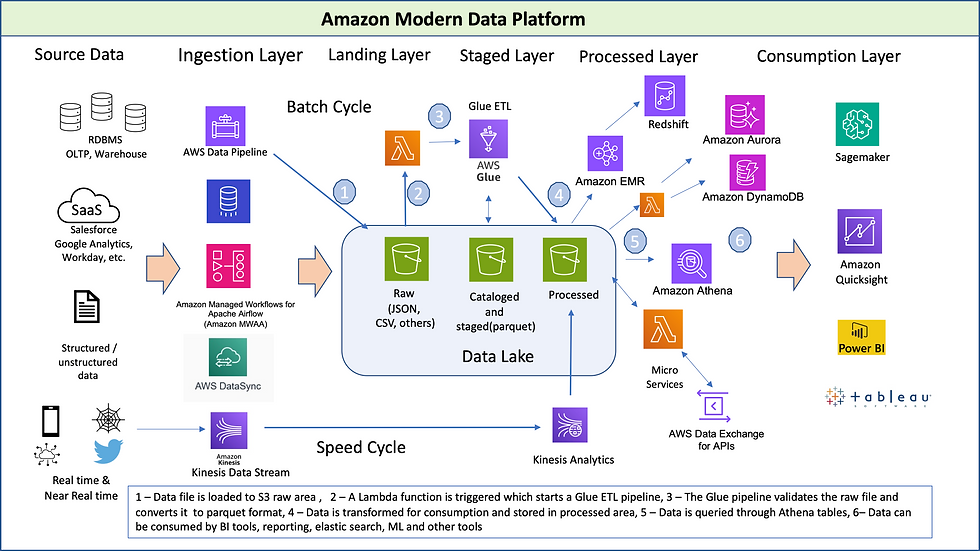
The Modern Data Platform on AWS is a comprehensive and integrated set of technologies, tools, and services that enable organizations to collect, store, process, manage, and analyze data in a unified and scalable manner.
It includes a wide range of AWS services such as Amazon S3 for storage, Amazon Redshift for data warehousing, Amazon EMR for big data processing, AWS Glue for data integration, Amazon Athena for querying data in S3, and Amazon QuickSight for visualization.
The focus of the Modern Data Platform is on providing a flexible and scalable infrastructure for managing all types of data (structured, semi-structured, and unstructured) and supporting various data processing and analytics use cases.
Amazon Lakehouse:
The Lakehouse architecture, on the other hand, is a modern data architecture that combines the best features of data lakes and data warehouses into a single platform.
It leverages the scalability and flexibility of data lakes (such as Amazon S3) for storing raw, unstructured data, along with the performance and query capabilities of data warehouses (such as Amazon Redshift) for processing and analyzing structured data.
The Lakehouse architecture aims to address the limitations of traditional data lakes (such as lack of schema enforcement and governance) while retaining their cost-effectiveness and scalability.
By integrating data lakes and data warehouses, the Lakehouse architecture provides a unified platform for storing, managing, and analyzing both raw and structured data, making it easier for organizations to derive insights from their data.
In summary, while the Amazon AWS Modern Data Platform is a broader framework for managing data and analytics on AWS, the Amazon Lakehouse is a specific architectural approach that combines the strengths of data lakes and data warehouses for more efficient data management and analytics.
IAM Roles Required for Creating and Using Amazon AWS Modern Data Platform
Creating and using an Amazon AWS modern data platform requires several IAM (Identity and Access Management) roles with specific permissions to interact with various AWS services. Below are some common IAM roles and their associated permissions:
Administrator Role:
This role has full access to all AWS services and resources.
It is typically used by administrators to manage IAM roles, policies, and other resources.
Data Engineer Role:
This role is responsible for provisioning and managing data-related services such as S3 buckets, Redshift clusters, Glue databases, and EMR clusters.
Permissions may include:
AmazonS3FullAccess: Full access to Amazon S3 for storing and managing data.
AmazonRedshiftFullAccess: Full access to Amazon Redshift for creating, managing, and deleting clusters.
AWSGlueServiceRole: Role required for AWS Glue to access AWS resources.
AmazonEMRFullAccess: Full access to Amazon EMR for creating and managing clusters.
AmazonAthenaFullAccess: Full access to Amazon Athena for querying data in S3 using SQL.
Data Analyst Role:
This role focuses on analyzing data using services like Athena, QuickSight, and Data Pipeline.
Permissions may include:
AmazonAthenaQueryExecuion: Permission to execute Athena queries.
AmazonQuickSightFullAccess: Full access to Amazon QuickSight for creating, managing, and viewing dashboards.
DataPipeline_FullAccess: Full access to AWS Data Pipeline for creating and managing data pipelines.
Data Scientist Role:
This role involves building and training machine learning models using services like SageMaker and Lambda.
Permissions may include:
AmazonSageMakerFullAccess: Full access to Amazon SageMaker for building, training, and deploying machine learning models.
AWSLambda_FullAccess: Full access to AWS Lambda for running serverless functions.
AmazonKinesisFullAccess: Full access to Amazon Kinesis for collecting, processing, and analyzing real-time data streams.
Data Security Role:
This role is responsible for managing security-related tasks such as encryption, access control, and compliance.
Permissions may include:
AWSKeyManagementServiceFullAccess: Full access to AWS Key Management Service for managing encryption keys.
AWSIAMReadOnlyAccess: Read-only access to IAM for viewing IAM roles, policies, and users.
AmazonGuardDutyReadOnlyAccess: Read-only access to Amazon GuardDuty for monitoring AWS accounts for security threats.
These roles can be customized based on the specific requirements of your modern data platform and the services you plan to use. It's essential to follow the principle of least privilege and grant only the permissions necessary for each role to perform its intended tasks. Additionally, consider using IAM policies with conditions to enforce additional security controls, such as restricting access based on IP addresses or requiring multi-factor authentication.